

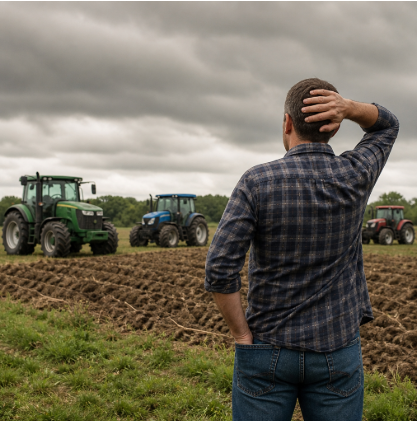
Most people who buy their first compact tractor buy it twice. The first machine is chosen on a sunny afternoon with a mower deck in mind, and the second is chosen eighteen months later, after a loader bucket full of wet gravel has shown exactly where the limits were. Getting the sizing right the first time is less about horsepower bragging rights and more about honest arithmetic: how many acres, how steep, how often, and which implements you will genuinely hitch up more than twice a year.
Start with the work, not the horsepower figure
Horsepower is the number on the brochure, but it is rarely the number that stops you. Hydraulic flow, three-point hitch lift capacity, rear axle weight and wheelbase decide whether a tractor can actually finish a job. A machine with ample engine power and a light rear end will spin, hop and lift the front wheels when you ask the loader to do real work. Write down your tasks in order of frequency and difficulty, then size for the second-hardest one — the hardest job is usually a once-a-year problem better solved by a contractor or a rented machine.
Rough sizing by property type
- Up to about 3 acres, mostly mowing and light hauling: a sub-compact or small compact with a mid-mount deck, a loader and a box blade covers nearly everything.
- 5 to 20 acres with fencing, food plots and a gravel drive: a compact tractor in the mid-range with a loader, rotary cutter, box blade and post-hole digger. Four-wheel drive stops being optional here.
- 20 to 60 acres with small-square hay or round bales: a utility tractor with the rear axle weight and hydraulic capacity to run a disc mower or mower-conditioner, a rake and a baler, plus a loader rated for bale spears.
- Steep or terraced ground: size down on width and up on stability — a wider stance, lower centre of gravity and loaded rear tyres beat extra horsepower on a slope every time.
One practical rule: a rotary cutter wants roughly 5 horsepower per foot of cutting width for pasture work, more for heavy brush. A tiller wants slow, steady PTO power and plenty of rear weight. Hay equipment is the fussiest of all, because the baler sets the floor — if your tractor cannot keep a consistent PTO speed up a slope with a full chamber behind it, you will make poor bales no matter how good the hay is.
Packages versus piecemeal buying
Buying a tractor and implements together usually saves you a season of fiddling. A matched package means the loader is rated for the machine, the rotary cutter is within the PTO’s comfortable range, and the quick hitch actually fits the implement pins. Piecemeal buying works well for experienced operators who know their hitch categories and hydraulic couplers, and it is often the cheaper route for used gear — but it puts the compatibility risk on you. If you are not confident reading a spec sheet for lift capacity at the hitch pins versus 24 inches behind them, a pre-matched package is money well spent.
Where a local dealer earns its keep
The dealership relationship matters more than most first-time buyers expect, because the real cost of a tractor shows up in downtime during hay season, not on the day of purchase. A parts counter that can identify a filter, a mower spindle or a baler pickup tooth from your model and serial number saves days. For readers farming or managing acreage in Kentucky, Tennessee or Indiana, H&R Agri Power is an authorized Kubota dealer that sells new and used machines, builds pre-made and custom tractor packages, and stocks genuine Kubota parts alongside general tractor, mower and baler parts — so it is a sensible place to compare Kubota tractors in stock against what your ground actually demands, with repair service at its locations and lawn mower repair available in Owensboro when the smaller machines need attention too.
Genuine parts: when it matters and when it doesn’t
Not every component justifies a premium. Shear bolts, pins, tyres and general hardware are commodity items. Where genuine parts repay the difference is in anything that protects the engine or the drivetrain, or anything whose failure happens at speed. Oil, fuel and hydraulic filters are the obvious case — filtration media quality and bypass valve calibration vary more than the outside of the can suggests. The same goes for mower blades and spindles, clutch packs, and baler wear components where fit tolerances decide whether the machine holds timing. A useful test: if a cheap part fails, will it cost you a part, a day, or a transmission?
A seasonal checklist that actually gets done
- Pre-spring (before the first mow): change engine oil and filter, inspect air filter, grease every zerk on loader and implements, check tyre pressures including the fronts, sharpen or replace mower blades, test battery under load.
- Pre-hay: replace hydraulic filter if due, inspect PTO shaft guards and U-joints, check driveline slip clutch, examine baler belts or rollers and twine path, set knife and ledger clearances on the mower.
- Mid-season (every 50 hours of hard work): clean the radiator screen and oil cooler, blow out the cab filter, re-grease pivot points, check coolant and look for weeping hoses.
- Autumn: fuel treatment and a full tank to limit condensation, grease exposed cylinder rods, wash salt and chaff off the undercarriage, store implements on blocks rather than bare soil.
- Winter: book service work now. Shops are quiet, parts lead times are shorter, and you are not competing with every other operator whose baler died in July.
The data layer small producers can no longer ignore
Equipment decisions now sit inside a wider shift in how food is tracked from field to plate. Researchers writing about big data coming to dinner describe supply chains where yield, input and provenance records travel with the crop — and even modest operations selling hay, produce or pasture-raised meat are being asked for cut dates, bale counts and field records. Hour meters, service logs and implement maintenance histories are quietly becoming part of that paperwork, which is one more reason to keep receipts and serial numbers somewhere other than the glovebox.
Why any of this reaches the dinner table
Readers tend to meet small-farm output at the end of the chain rather than the start. The same curiosity that sends someone hunting for a good plate of mercimek köfte on a weekday evening increasingly extends to where the lentils, bulgur and herbs were grown and who baled the forage that fed the livestock nearby. Machinery choices sit upstream of all of it: a correctly sized tractor that starts on a damp morning is the difference between hay cut at the right moisture and hay cut three days late.
The short version
Size for the second-hardest job you do regularly. Prioritise lift capacity, hydraulic flow and rear axle weight over headline horsepower. Buy matched implements if you are new to hitch categories, and buy used selectively once you can read a spec sheet. Spend on filtration and wear parts, save on hardware. Then write the service dates on a calendar in January, because the tractor you maintain in winter is the one that works in July.
Why UK Equity Income Funds Still Matter for Investors Seeking Dividends