

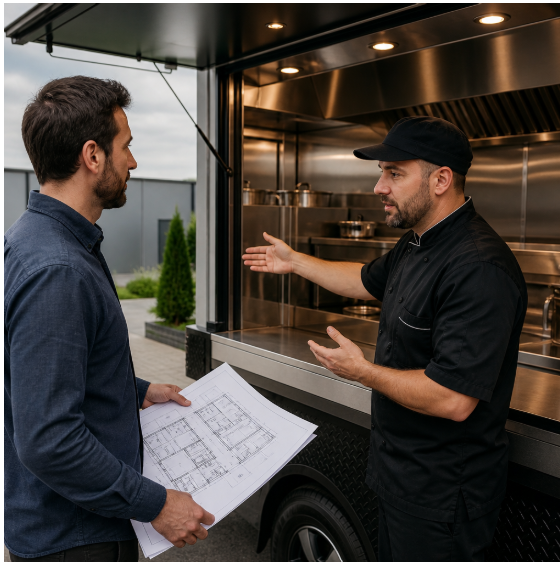
Most mobile kitchens fail on paper long before they fail on site. The owner buys the shiny unit first, then tries to squeeze a menu, a service window and three members of staff into whatever space is left. Done the other way round — menu, workflow, utilities, then shell — a mobile unit becomes a predictable business rather than an expensive hobby. The same logic applies to any purpose-built vehicle on an event site, whether it is a kitchen, a stage, a production base or a brand activation truck.
Here is a specification-led way to plan one, written for operators who already know how to cook and now need to know how to build.
Step one: write the menu before you draw the trailer
The menu dictates every major decision: how many burners, whether you need a fryer and therefore extraction and fire suppression, how much cold storage, and how long a queue you can realistically clear. A three-item menu with one cooking method and one assembly point will out-earn a ten-item menu in the same footprint, because throughput — covers per hour — is the only number that matters once you have paid your pitch fee.
Choose dishes that survive the realities of service: holding, reheating, and being eaten standing up with one hand. Small-plate cooking travels particularly well, which is why so many street food operators borrow from tapas. A dish like fried aubergine with honey, done properly, is instructive — it needs one cooking station, holds its texture for a few minutes, and plates in seconds. Map each menu item to a station, then count the stations. That count is your floor plan.
A simple throughput test
- Time yourself producing one portion, start to hand-off, in a domestic kitchen.
- Multiply by the number of simultaneous orders you can realistically run.
- Assume you will lose roughly a third of that capacity on a busy site to payment, allergen questions and refills.
- Compare the result with the footfall your target events actually deliver.
Power, water and waste: the three constraints that bite
Almost every late-stage build change comes from one of these three. Electrical load is the most common. Add up the continuous draw of refrigeration, extraction, lighting, water heating and payment hardware, then add cooking equipment if it is electric rather than gas. Decide early whether you are hooked up to site power, running a generator, or running a hybrid with battery support. A unit designed for a 16-amp hook-up behaves very differently from one designed for a 32-amp supply, and retrofitting the difference means re-cabling.
Water is simpler but heavier. Fresh and waste tanks need to be sized for a full trading day without a refill, because you cannot count on a tap being within hose reach. Every litre you carry is weight, and weight interacts with your towing or driving entitlement. Waste — grey water, used oil, food packaging — needs a designated place in the build, not a bucket wedged under a counter. Gas, where used, brings its own documentation and routine inspection, so build in access for the engineer rather than burying the manifold behind a fridge.
Layout: design for the worst twenty minutes of the day
Lay the unit out for peak, not for the quiet midweek market. That means a service hatch with enough counter for collection and payment to happen side by side, a cold-to-hot-to-pass flow that does not cross itself, and somewhere for staff to stand that is not the doorway. Keep walkways clear enough for two people to pass back to back, and put hand-wash where it is actually reachable at the moment hands get dirty.
Think about set-up and pack-down as part of the layout too. Awnings, signage boards, A-frames, stock crates and chairs all need stowage that locks for transit. Operators who have to unload six loose items before they can serve lose half an hour at both ends of every day, which across a season is a meaningful amount of trading time.
Choosing a build route
There are broadly three routes. A second-hand unit is the cheapest entry and the quickest start, with the trade-off that your menu has to fit someone else’s decisions. A stock new-build from a volume supplier gives you reliable fittings and a known layout, with limited scope for anything unusual. A bespoke build starts from your drawings and is the right answer when the unit has to do something a catalogue model cannot — an unusual service configuration, integrated staging or display, a long-life shell for heavy touring, or a combination of kitchen and hospitality space in one chassis.
If you land in that third category, it pays to look at fabricators who build across vehicle types rather than kitchens alone. Firms working in custom vehicle fabrication — companies such as Craftsmen Industries, which designs and builds specialty trailers and vehicles including mobile command centres, commercial kitchen and food trailers, mobile stage and film set trailers, and promotional and experiential marketing vehicles — tend to approach a unit as an engineered platform first: chassis, load distribution, utilities, then interior. That mindset matters when your unit will spend years being towed, levelled, plugged in and powered down on uneven ground, and it is also why the same discipline turns up in government, emergency response and production work. Bring them a dimensioned layout, an equipment schedule and a load list, and the conversation starts in the right place.
Budgeting in buckets, not guesses
Rather than chasing a single headline figure, split the budget into buckets and populate each with real quotes: shell and chassis; cooking and refrigeration equipment; electrical and gas systems; water and waste; counters, finishes and branding; compliance and registration; and a contingency you do not touch. Then build a second, smaller budget for the things that never make the first draft — spare gas regulators, a second card reader, levelling ramps, fire extinguishers, cleaning chemicals, a spare wheel and the tools to change it.
Running costs deserve the same treatment. Fuel, pitch fees, staff, insurance, waste disposal, servicing and storage are the figures that decide whether a good trading day is actually profitable. Operators who track cost per cover from week one make much better decisions about which events to return to, and the broader context helps: it is worth reading industry leaders discussing where the event sector is heading before committing to a calendar built entirely around one type of booking.
Shake it down before the season starts
Give the finished unit at least two low-stakes outings before a major booking. Trade a quiet market, time your set-up, run the generator to its limits, fill and empty the tanks, and note every annoyance. Fix the small things immediately — the drawer that opens in transit, the socket behind the fryer, the hatch strut that fouls the signage. The difference between a unit that lasts a decade and one that is sold at a loss after two seasons is usually a dozen unglamorous details, identified early and designed out rather than lived with.
Specify from the menu outward, respect power, water and weight, and treat the build as engineering rather than decoration. Do that, and the vehicle stops being the risk in your business and becomes the reason it scales.