
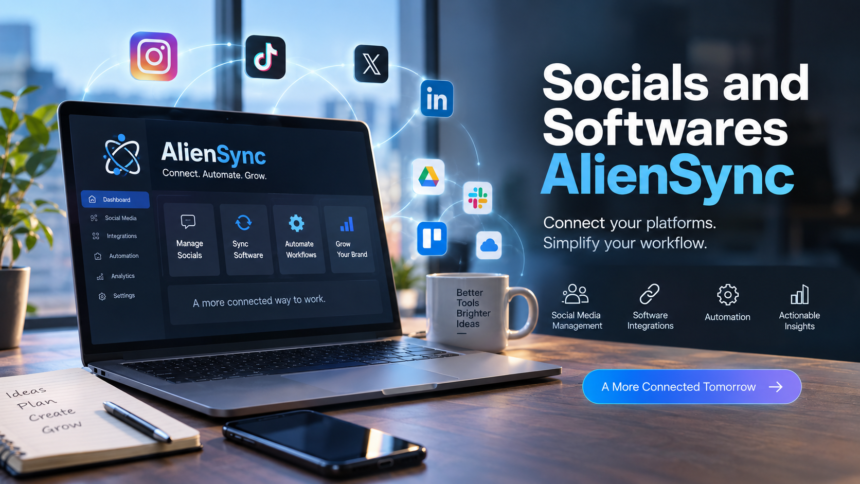
The phrase socials and softwares AlienSync sounds like the name of a social-media management or software-integration product. Based on AlienSync’s public material, however, that interpretation needs qualification.
As of September 8, 2026, the clearest evidence shows that AlienSync.com operates primarily as a technology publishing website covering apps, social media, software, blockchain, crypto and related digital topics. AlienSync also publishes articles describing a broader concept for synchronising social platforms, business applications and data workflows. Crucially, one of AlienSync’s own July 2026 explainers says there are no confirmed public SDKs or documented APIs and describes the brand as primarily editorial and conceptual rather than a clearly verifiable downloadable product.
That matters because other pages on the same website describe AlienSync much more like a finished SaaS platform, complete with account creation, social scheduling, dashboards, OAuth connections, analytics and integrations. The safest interpretation is therefore not “AlienSync definitely offers all these software features,” but rather: AlienSync is a technology-content brand that also publishes a conceptual model of connected social and software workflows, while its claims about a deployable software product remain inconsistent.
What does “socials and softwares AlienSync” refer to?
The wording appears to combine the AlienSync name with one of the site’s main editorial categories, “Apps – Socials & Software.” That category contains articles about software, apps, social platforms, customer engagement, e-commerce integrations and other technology subjects. It is visibly a publishing archive rather than a software dashboard or integration marketplace.
AlienSync’s About page supports the same interpretation. It introduces the site as an editorial destination covering blockchain, crypto, “socials and software” and technology trends, and describes named contributors as editors rather than presenting a product team, software documentation centre or customer application.
So the exact search phrase socials and softwares AlienSync is better understood as a label associated with AlienSync’s coverage of social platforms and software, plus a broader idea of connecting those tools, rather than as the verified name of one conventional software package.
Why AlienSync is so easy to misunderstand
The confusion comes largely from AlienSync’s own content.
A July 31, 2026 page titled What Is Socials and Software AlienSync? says AlienSync is “primarily an editorial and conceptual brand” and states that no public SDKs or documented APIs have been confirmed. It also says references to APIs should be treated as illustrative and that the site’s integration descriptions resemble conceptual blueprints rather than verified developer documentation.
Yet another AlienSync page published on the same date describes AlienSync as a cross-platform social-media and workspace tool. That article tells readers to install the app, create an account, connect social profiles and use scheduling, analytics and automation features. It also mentions Google Workspace, Slack and Trello integrations and discusses supposed pricing tiers.
An August 3 guide goes further. It describes a signup process, an “Integrations or Accounts” section, OAuth authorisation, AI-recommended posting times, a visual content calendar, team roles and analytics. It even includes performance examples attributed only to unnamed brands or teams.
Those descriptions cannot simply be combined into a single product specification because AlienSync’s more cautious pages explicitly say that the necessary public product evidence has not been confirmed.
What is actually verified?
The difference between observable facts and product claims is the most useful way to understand AlienSync.
| Claim | What the available evidence shows |
|---|---|
| AlienSync is a technology website | Clearly supported by its About page, category archives and published articles. |
| AlienSync discusses social and software integration | Clearly supported. Synchronisation, automation, social platforms, apps and workflows appear repeatedly in its editorial material. |
| AlienSync is a downloadable SaaS application | Not established consistently. AlienSync itself says evidence points to a content-first operation rather than a verifiable SaaS listing. |
| Public AlienSync APIs and SDKs exist | AlienSync’s own explainer says no verified public APIs or SDKs have been confirmed. |
| Instagram, TikTok, X and LinkedIn are supported integrations | AlienSync articles claim these integrations, but another AlienSync page explicitly says those descriptions come from blog content rather than verifiable product documentation. |
| A public pricing system exists | Product-style pages discuss tiers, but AlienSync’s more cautious material says no verifiable signup or pricing pages for a live SaaS product have been established. |
This distinction is more useful than trying to decide whether every AlienSync article is “right” or “wrong.” The website clearly exists and publishes extensively. The connected-workflow concept is also technically plausible. What remains unclear is whether all of the product-style features described across that content are available together in a functioning, publicly documented AlienSync service.
Which social platforms does AlienSync claim to support?
AlienSync has published content naming Instagram, TikTok, X and LinkedIn as platforms associated with its social-integration concept. Other pages also mention Facebook and productivity or analytics services.
But AlienSync’s own August 2, 2026 article makes an unusually useful clarification: it says these platform descriptions are taken from blog material, lack verifiable API documentation or downloadable tools, and should be regarded as claimed compatibility rather than confirmed connections.
That means a reader should not interpret “AlienSync supports Instagram” in the same way they would interpret an integration listed in an established software vendor’s official integration directory with setup instructions, permission scopes and working developer documentation.
The underlying workflow being described is nevertheless familiar: a business might connect content creation, project-management, analytics and social publishing so that one event triggers actions in several systems. AlienSync frequently uses that kind of architecture to explain the value of synchronisation. The concept is real; the question is whether AlienSync itself currently supplies the complete software layer described in those examples.
Can you create an AlienSync account and use a dashboard?
Some AlienSync articles instruct readers to create accounts, choose plans, connect services and manage campaigns from a dashboard.
However, the site’s July 31 explainer says public material describes onboarding this way while also acknowledging that verifiable signup and pricing pages for a live SaaS product have not been established. It advises readers to treat those setup descriptions more like playbooks than formal product documentation.
For that reason, instructions such as “install AlienSync,” “choose a plan” or “connect your Instagram account” should not be presented as independently confirmed steps.
What about AlienSync’s privacy and security claims?
Security deserves particular care because connecting social accounts can involve valuable permissions and access tokens.
AlienSync has a Privacy Policy, but the policy primarily describes the website: visitor log files, IP addresses, browsers, cookies, advertisers and website analytics. It does not function as detailed documentation for a social-media SaaS platform handling connected accounts, social tokens, campaign content or enterprise customer data.
Its Terms and Conditions are similarly framed around use of the AlienSync website, website content, comments, links and intellectual-property rules. The terms refer generically to “the Company” rather than presenting the kind of detailed service agreement one might expect to evaluate a business-critical integration platform.
This does not prove that AlienSync is unsafe. It means the public documentation reviewed here is not enough to substantiate all of the product-level security claims found in some AlienSync articles.
That is particularly relevant when OAuth is mentioned. OAuth is a legitimate, widely used authorisation framework, but merely saying that a service “uses OAuth” does not demonstrate that its implementation is secure. The IETF’s current OAuth security best-practice document covers issues including redirect validation, token protection and other implementation safeguards.
A credible account-connection workflow should therefore be judged by the actual authorisation screen, requested permissions, documentation and security practices—not simply by the presence of the word “OAuth” in a blog post.
What is useful about the AlienSync idea?
Stripped of uncertain product claims, AlienSync’s central idea is straightforward: organisations increasingly work across disconnected systems, and automation can reduce repetitive transfers between them.
A marketing workflow, for example, could theoretically connect an approved product update with a project-management task, a content queue, a social post and an analytics record. AlienSync describes this kind of flow using concepts such as triggers, connectors, rules, APIs, webhooks and synchronisation layers.
Those concepts are useful even if AlienSync is treated as an editorial resource rather than as the software implementing them. Readers researching workflow automation can use the examples to think about questions such as which system should be the authoritative source for a piece of data, what should trigger an automated action, which permissions an integration needs and what happens when two systems contain conflicting information.
The important boundary is between learning from the architecture and assuming the illustrated architecture is a currently available AlienSync product feature.
How to evaluate AlienSync before connecting a real account
Before giving any AlienSync-branded service access to a social profile, business application or customer data, verify the specific service you are using rather than relying on feature articles alone. Look for a functioning product portal; current pricing or contractual information; a documented integration directory; developer or API documentation where relevant; clear privacy and security information covering the actual service; an OAuth screen that identifies the application and requested permissions; support information; and independent evidence that the product is actively used.
This is consistent with AlienSync’s own more cautious guidance, which tells readers to validate claimed integrations with concrete product documentation before managing live accounts.
The clearest way to understand socials and softwares AlienSync
For someone searching socials and softwares AlienSync, the most accurate answer in September 2026 is that AlienSync is clearly a technology-content website and also publishes a conceptual framework around synchronising apps, social networks and software workflows.
It should not currently be described without qualification as a fully verified social-media management or integration SaaS product. AlienSync’s own pages conflict on that point: some describe detailed product functions, while others explicitly acknowledge that public APIs, SDKs, signup pages, pricing and integration documentation have not been verified.
Readers can therefore use AlienSync’s social-and-software material as technology content and workflow inspiration, while treating specific claims about dashboards, integrations, pricing, AI tools, security standards or downloadable applications as claims that need separate confirmation.
Sources
- AlienSync — “What Is Socials and Software AlienSync?” — July 31, 2026. https://aliensync.com/what-is-socials-and-software-aliensync/
- AlienSync — “Which Social Media Platforms Work With AlienSync?” — August 2, 2026. https://aliensync.com/which-social-media-platforms-work-with-aliensync/
- AlienSync — “Apps and Software AlienSync: The Complete Guide” — July 31, 2026. https://aliensync.com/apps-and-software-aliensync-the-complete-guide/
- AlienSync — “How to Schedule Social Media Posts With AlienSync” — August 3, 2026. https://aliensync.com/how-to-schedule-social-media-posts-with-aliensync/
- AlienSync — About Us; Privacy Policy; Terms and Conditions — no publication/update date displayed on the opened pages. https://aliensync.com/about-us/ https://aliensync.com/privacy-policy/ https://aliensync.com/terms-and-conditions/
- RFC Editor / IETF — RFC 9700, “Best Current Practice for OAuth 2.0 Security” — January 2025. https://www.rfc-editor.org/info/rfc9700/