
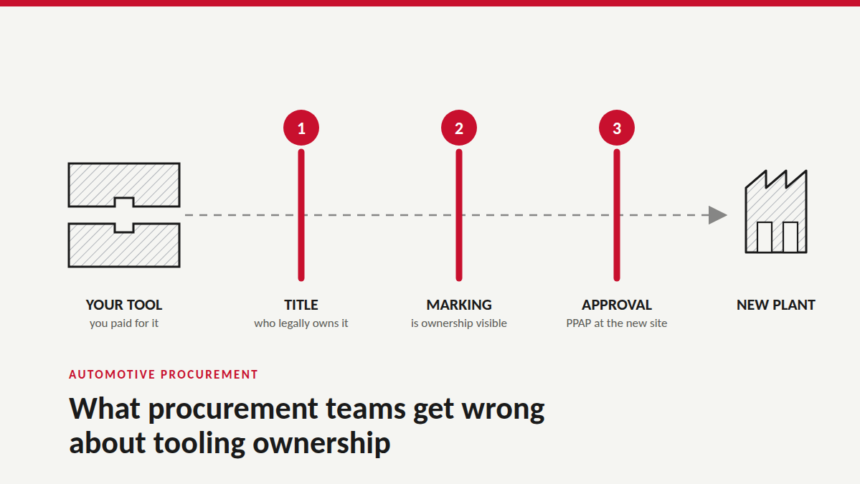
Most automotive procurement teams assume the tool they funded is theirs to move. Whether that holds depends on three things, and you settle all of them at sourcing, years before the relationship turns.
A supplier misses delivery for the third month running. Or raises prices at renewal by more than you can pass on. Or calls on a Friday to say the plant is going into administration. You open the file, find the purchase order for the tool you paid for, and start planning the move.
What happens next rests on paperwork you signed years ago and probably skimmed.
Paying for a tool is not the same as owning it
A tooling payment buys you a tool. It does not automatically buy you title to that tool, the right to remove it from the supplier’s floor, or the process documentation that makes it produce a good part.
Read what your purchase order says about when title passes. Some agreements transfer ownership on final payment. Others wait for successful part approval. Many say nothing at all, and in a dispute the supplier’s standard terms fill that silence. Look for a lien clause while you are there, because a supplier owed money for production can often hold a tool against that debt even when the tool is legally yours.
Ask for the tooling agreement as a document in its own right rather than a line on the quotation. A mould tool for an interior trim part takes months to replace and costs more than most buyers have sitting in a contingency budget, so it deserves more than a reference number. If a supplier resists putting ownership, removal rights and storage obligations in writing, you have learned something useful before you commit.
If it is not marked, proving it is yours gets harder
IATF 16949 requires that customer owned tools, manufacturing equipment and test and inspection equipment are permanently marked in a visible location, so that ownership and application can be determined. Suppliers certified to the standard should already do this.
Plenty of tools on plant floors carry no marking at all, and the gap surfaces at the worst possible moment. When an administrator walks into a plant holding tooling from a dozen customers, an unmarked tool counts as an asset of the business until someone proves otherwise. Proving otherwise costs legal time you do not have while a line stands still.
Write tool marking into the agreement, ask for a photograph of the marked tool inside the part approval pack, and check it again at every audit.
Moving a tool restarts the approval clock
Clean title and a marked tool still will not get you a weekend transfer. Under the AIAG production part approval rules, production from tooling and equipment transferred to a different plant site, or from an additional plant site, requires customer notification, and submission follows unless your customer specifies otherwise.
In a project plan that means a significant run at the new site, dimensional results, capability studies and your own customer’s sign off before saleable parts ship. Put that time and cost in the business case for switching. A quote comparison that leaves requalification out will point you at the wrong supplier.
A second trap sits in the same rules. Tooling that has been inactive for volume production for twelve months or more also triggers notification. If you dual sourced a part and one tool has sat idle through the year, that second source is slower to wake up than your risk register suggests.
Settle this at sourcing, not at exit
Seven questions belong in the agreement before the first purchase order:
- Who holds title to the tool, and at what point does it pass to you
- Whether the supplier can exercise a lien over the tool against unpaid production invoices
- Which site the tool physically sits in, and whether moving it between the supplier’s own sites needs your consent
- Who owns the process documentation: flow analysis, gate and runner layout, machine settings, the parameters that produce a passing part
- What the supplier charges for removal, crating and handover
- How quickly the supplier must release the tool after a termination notice
- Whether maintenance history and shot counts are recorded and available to you
None of that is unreasonable to ask. A supplier running a proper tooling management system already holds the answers, and the ones that do not will tell you something by how long they take to reply.
When your supplier does not own the plant
A disclosure before this section. I work for Coler Supply Solutions, a procurement and contract manufacturing business that runs on the model described below, so weigh what follows accordingly.
Contract manufacturers and procurement partners regularly place work across plants they do not own. That is not a problem in itself, and for low to medium volume automotive components it is often the only route to the right process at a workable cost. It does change the questions you ask.
Find out which legal entity holds your tool, which site it physically sits in, and whether your contract runs with the company invoicing you or with the plant doing the work. Ask where each certification sits, because the partner plant may hold IATF 16949 while the company you buy from holds ISO 9001. Both can be true at once, and your auditor will want to know which is which.
The practical test takes one email. Ask your supplier to confirm in writing the address where your tool currently sits and the name of the entity that would have to release it. How fast that answer comes back tells you how well your tooling is being managed.
Read also Travelling to India for a wedding without overloading the trip