

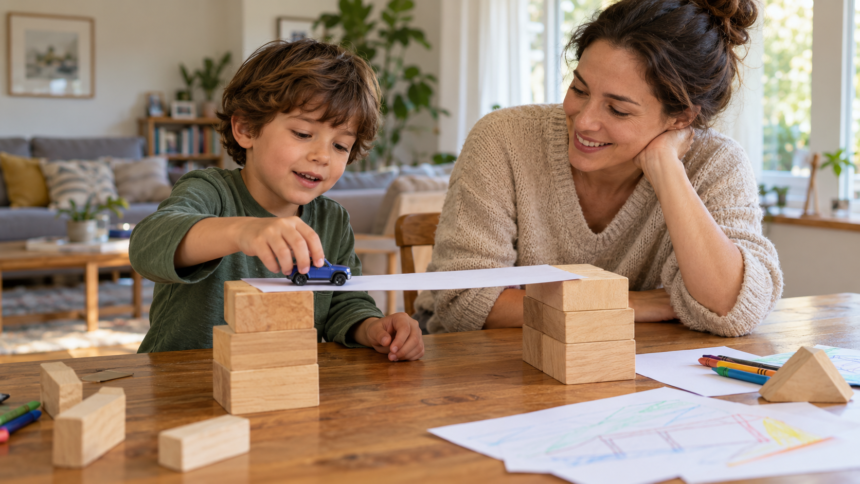
Active learning means children take part in learning. They think, ask questions, make choices, and try ideas. Parents can support this through play, conversations, and everyday tasks. The key is helping children think about what they are doing.
If you searched for “active learning guide fparentips,” that title appears on FParentips.com. Its article discusses learning at home through everyday activities. Here is how to put the broader idea into practice.
What counts as active learning?
An activity involves active learning when a child uses their mind to explore or understand something. Moving objects around can help, but keeping busy is not the whole goal.
For example, a child might build a tower and notice why it falls. During a story, they might guess what a character will do next. Both give the child something to think about.
The National Association for the Education of Young Children describes playful learning as mentally active, meaningful, and engaging. It also includes social interaction and chances to try again.
How much should parents help?
Children do not need to work everything out alone. Adults can explain a new word, show a step, or offer a clue.
In guided play, an adult has a learning goal but leaves room for the child’s choices. For example, you might encourage a child to explore shapes while they decide what to build.
Try to match your help to the task:
- They are exploring comfortably: Watch and give them time.
- They seem unsure: Offer a small clue or two choices.
- They lack a needed skill: Show one step, then let them try.
- They are upset or tired: Help, simplify the task, or take a break.
A simple way to start at home
Use these steps as a flexible starting point, not a fixed lesson plan.
- Choose something your child already enjoys. Start with stories, drawing, toys, or a household task.
- Pick one small focus. You might practise counting, comparing sizes, or describing what happened.
- Invite a choice or prediction. Ask what they want to try or what they think will happen.
- Let them take part. Give them time to act, notice, and change their idea.
- Look back together. Ask what worked. A short answer, gesture, or demonstration is enough.
Hypothetical example: Your child wants to make a paper ramp for a toy car. Ask which slope might make the car travel farther. Try two slopes, compare the results, and let your child choose what to change next.
Everyday activities to try
These are suggested activities, not a tested programme. Choose materials and tasks that suit your child’s abilities. Use large, age-appropriate materials for young children and supervise as needed.
| Activity | Invite your child to do this | Possible learning focus |
|---|---|---|
| Put clothes away | Group socks and explain how they sorted them | Matching and describing |
| Set the table | Work out how many spoons each person needs | Counting and checking |
| Share a picture book | Use a picture to guess what happens next | Understanding a story |
| Draw a route through a room | Show how to get from the door to a chair | Position and direction |
| Make a paper bridge | Test whether it holds a toy, then change its shape | Comparing and solving problems |
Make a task easier by reducing the choices or showing an example. Make it harder by asking your child to compare two approaches.
Ask questions without turning play into a test
Try one question, then pause:
- “What do you notice?”
- “What could we try next?”
- “How could we check?”
- “Can you show me what you mean?”
You can also make a comment: “That piece keeps sliding.” Then wait to see how your child responds.
For very young children, follow their looks, gestures, and sounds. Harvard’s Center on the Developing Child explains that responsive, back-and-forth exchanges support early language and social skills. A child does not need a spoken answer for you to respond warmly.
What if an activity does not work?
If your child loses interest, change the task or leave it for another day. Avoid treating one difficult activity as a measure of their ability.
Give clear explanations when needed. Active learning can sit alongside teaching and practice; it does not require children to discover every answer themselves.
Screens also need careful choices. An “educational” label alone does not show that an app supports learning. If you use one, look for a clear task that asks your child to think. You might then invite them to explain an idea or try it away from the screen.
Start with one familiar moment today. Give your child a useful choice, time to try, and enough help to keep going.
Read also VozolVapen: An Overview of Vape Brands, Wholesale Options and EU Shipping
Read also Almawadahit.com Technology: What Readers Should Know