

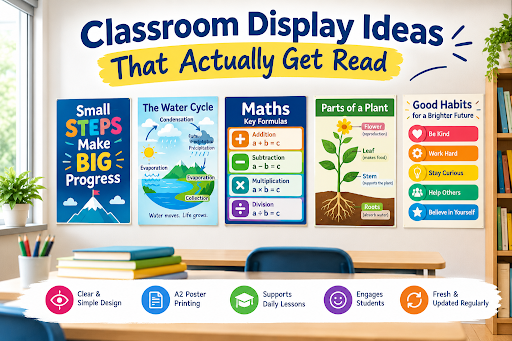
Classroom displays can do more than decorate school walls. They can help students learn, remember key facts, and take an active interest in their lessons. The trick is to create displays that are easy to read, useful, and interesting enough to catch attention.
Choosing the right size, colours, images, and words can make a big difference. With A2 poster printing, teachers can create clear learning materials that fit classroom walls, notice boards, and reading corners without taking up too much space.
1. Keep Classroom Posters Simple
Students are more likely to read a poster when its message is clear. Too much text, tiny fonts, and crowded layouts can make even useful information difficult to follow.
Use a short headline, a few key points, and relevant pictures to explain the topic. For example, a science poster about the water cycle can show each stage with a short description rather than several long paragraphs.
For better results:
- Use large, easy-to-read fonts.
- Keep sentences short and clear.
- Highlight important words with contrasting colours.
- Leave enough empty space between sections.
A simple layout helps students understand the message quickly, even when they only glance at the poster between lessons.
2. Choose the Right Poster Size
Poster size matters when planning classroom displays. A poster that looks clear on a computer screen may become difficult to read when printed and placed across a busy classroom.
A2 poster printing works well for subject summaries, classroom rules, vocabulary lists, and revision notes. Its size offers enough room for headings, pictures, and short explanations while remaining suitable for most classroom walls.
For larger spaces, large A1 posters can make important information easier to see from the back of the room. They are useful for classroom timetables, educational diagrams, safety instructions, and detailed learning charts.
Before ordering prints, consider the viewing distance, available wall space, and amount of information you need to include. Choosing the right dimensions helps keep your displays useful without making the classroom feel crowded.
3. Use Posters to Support Daily Lessons
The best classroom displays connect with what students are learning. Instead of filling every wall with general decorations, choose topics that support current lessons and help students revise independently.
Here are a few practical ideas:
- English: Display common spelling mistakes, grammar rules, punctuation examples, and new vocabulary.
- Mathematics: Create multiplication charts, fraction guides, geometry formulas, and problem-solving steps.
- Science: Show labelled diagrams of plants, the human body, the solar system, or the water cycle.
- History: Use timelines, historical maps, and short profiles of important people.
- Geography: Display world maps, country facts, climate zones, and landform diagrams.
Printed learning materials give students a useful reference throughout the school day. Teachers can also change displays as lessons progress, keeping the classroom fresh and relevant.
4. Make Reading Easy From a Distance
A poster cannot do its job if students struggle to read it. Text size, contrast, and layout all affect how easily learners can understand the information.
Choose dark text on a light background, or light text on a dark background, to create a clear contrast. Avoid placing text over busy photographs because the words may become difficult to see.
Use headings to divide information into sections and make key facts stand out. For posters intended for the whole class, test the design from the back of the room before sending it for printing.
Large-format prints can be especially useful for shared learning materials. However, bigger does not always mean better. The design must remain clear, balanced, and suitable for the students who will use it.
5. Add Student Work and Interactive Ideas
Classroom displays become more interesting when students feel connected to them. A wall filled only with printed information may be useful, but adding student contributions can encourage learners to stop, look, and participate.
Try these ideas:
- Create a word-of-the-week board where students add new words.
- Display the best examples of student writing or artwork.
- Use question-and-answer posters for quick revision.
- Add removable cards that students can match with the correct answers.
- Create a class achievement board to celebrate progress.
Printed posters can provide the main layout, while student work adds variety and personal meaning. This combination makes classroom walls feel more welcoming and gives learners a reason to revisit the displays.
6. Refresh Displays Throughout the Year
Even a well-designed poster can lose its impact if it stays on the wall for too long. Students may stop noticing information they see every day, so changing displays regularly can help maintain interest.
Update subject posters when a new topic begins, replace outdated classroom information, and introduce seasonal learning themes when appropriate. You do not need to change everything at once. Refreshing one section at a time can keep the classroom interesting without creating extra work.
Using A2 poster printing for topic-based materials gives teachers a practical way to prepare separate displays for different lessons. Store reusable designs carefully so they can be printed again when needed.
7. Get Better Results With Quality Printing
A good design deserves a clear, well-produced print. Blurry images, faded colours, and poor paper quality can reduce readability and make classroom materials look untidy.
When choosing a printing service, consider the following:
- Print clarity: Text and diagrams should have sharp edges.
- Colour quality: Colours should remain clear and easy to distinguish.
- Paper options: Choose a finish that suits the display location and expected handling.
- Suitable sizing: Make sure the final dimensions match your wall or notice board.
- Consistent results: Reliable printing helps maintain a neat appearance across multiple displays.
Professional printing can save teachers time and make educational materials easier to use. Whether you need a few subject posters or a complete classroom display set, plan the design and print size before placing your order.
Conclusion
Classroom displays work best when they deliver useful information in a clear and interesting way. Simple layouts, readable text, relevant images, and regular updates can encourage students to engage with classroom walls instead of ignoring them.
A2 poster printing is a practical choice for everyday learning materials, revision guides, and subject displays, while large A1 posters can help important information stand out in bigger classrooms. By choosing suitable sizes and quality printing, teachers can create displays that support learning and give students something worth reading.