

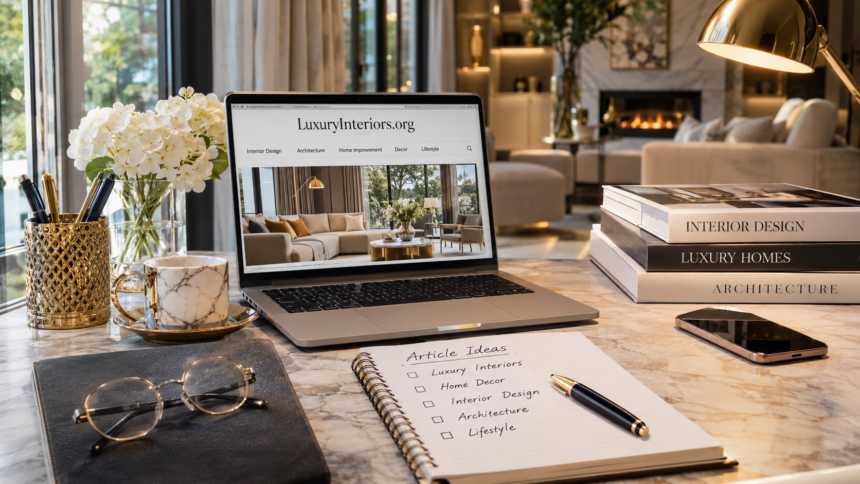
To start writing on LuxuryInteriors.org, explore the website’s content, choose an original topic related to interior design or luxury living, prepare a clear article proposal, and contact the website’s editorial team. A thoughtful idea, reliable research, and engaging writing can help you make a strong first impression.
Writing about beautiful homes, creative spaces, and modern architecture can be rewarding. It gives you the opportunity to share useful knowledge while developing your skills as a writer.
However, getting started involves more than putting words on a page. You need to understand your readers, find worthwhile subjects, and present information that feels natural and trustworthy.
Whether you are a beginner, an interior design enthusiast, or an experienced content creator, this guide explains how to approach writing opportunities on LuxuryInteriors.org and prepare articles that readers will enjoy.
What Is LuxuryInteriors.org?
LuxuryInteriors.org is an online publication that covers architecture, interior design, home improvement, decoration, and luxury lifestyle topics.
The website shares articles about beautiful living spaces, practical home improvements, architectural ideas, and different approaches to comfortable living.
Its content is relevant to people who enjoy decorating their homes, exploring design ideas, and learning about materials, furniture, and architectural styles.
For aspiring writers, understanding this focus is important. An article that fits the website’s subject matter has a stronger starting point than a generic piece written without considering its audience.
Good interior design writing should explain not only what looks attractive but also why a particular choice works.
That distinction can turn an ordinary decorating article into something genuinely useful.
Why Start Writing on LuxuryInteriors.org?
Writing about interiors allows you to explore a subject that combines creativity with everyday life.
A living room, for example, is more than a collection of furniture. Its layout, lighting, materials, and colors influence how people use and experience the space.
Explaining these details helps readers make better decisions about their own homes.
For writers, publishing articles on a relevant website can also support professional development. Published work may become part of a writing portfolio, allowing future clients or editors to assess your abilities.
Contributing to LuxuryInteriors.org may be worth exploring if your interests match its editorial subjects. However, publication, payment, and other contributor benefits should always be confirmed with the website before accepting an assignment.
The real value of a strong article comes from its usefulness, accuracy, and ability to communicate an idea clearly.
Understand the Website First
Before preparing your first article, spend some time reading the content already available on LuxuryInteriors.org.
Explore its architecture, design and decor, home improvement, and lifestyle sections.
Notice how articles introduce their subjects, explain design choices, and present practical information.
Pay attention to the questions readers might have after finishing an article. Identifying those unanswered questions can help you discover useful writing opportunities.
For example, an article about marble countertops may explain their appearance without discussing maintenance, staining, or installation considerations.
A carefully researched piece addressing these practical concerns could offer readers additional value.
Avoid simply rewriting an existing article with different words. A fresh perspective should provide information, examples, or explanations that readers cannot easily find in the original piece.
Understanding the publication’s content also helps you avoid submitting topics that do not fit its general direction.
Choose the Right Topic
Choosing a worthwhile subject is one of the most important steps when you start writing on LuxuryInteriors.org.
An effective topic should connect your interests with something readers genuinely want to understand.
Broad subjects such as luxury furniture or modern home decor can be difficult to cover properly in a single article.
A more focused idea usually produces a better result.
For example, instead of writing about luxury bedrooms in general, you could explain how layered lighting makes a bedroom feel warmer and more comfortable.
Similarly, an article about choosing upholstery for a family home offers a practical purpose beyond describing attractive furniture.
Other promising subjects include sustainable interior materials, small-space design, thoughtful kitchen layouts, architectural lighting, furniture craftsmanship, and the restoration of older homes.
You can also examine how design decisions affect maintenance, comfort, accessibility, and long-term costs.
The strongest article ideas usually answer one clear question rather than trying to cover everything about a subject.
Research Before You Write
Reliable research gives an article substance.
When discussing interior design, it is easy to rely on attractive photographs and general opinions. However, readers often need more specific information.
They may want to know whether a material is durable, how a furniture layout affects movement, or what maintenance a particular surface requires.
Begin with trustworthy information from manufacturers, professional designers, recognized industry organizations, and established publications.
For technical details, consult relevant professional guidance and product documentation instead of relying on unsupported claims.
If you are writing about natural stone, for instance, investigate its properties, recommended applications, and maintenance requirements.
If the subject is sustainable furniture, examine where the materials come from, how the products are made, and whether environmental claims have supporting evidence.
Research can also involve interviewing designers, visiting showrooms, or discussing practical experiences with homeowners.
These details add depth that generic advice often lacks.
Always verify important facts, measurements, prices, and product specifications before including them in an article.
Build a Strong Article Idea
A good article begins with a clear purpose.
Before writing, ask yourself what the reader should understand or accomplish by the end.
Imagine you want to write about choosing lighting for a luxury dining room.
Your central idea could be that successful dining room lighting requires more than an attractive chandelier.
The article might explain fixture placement, layered lighting, glare, dimming controls, and how the size of a room affects the final result.
This approach gives your writing direction.
It also makes the proposed article easier for an editor to evaluate.
Try expressing your idea in one sentence. If you struggle to explain it simply, the subject may need further refinement.
A focused article with useful examples is often more engaging than a broad article filled with general statements.
Prepare Your Writing Portfolio
A writing portfolio demonstrates how you organize information, research subjects, and communicate with readers.
You do not necessarily need years of publishing experience to prepare one.
If you are new to writing, create two or three original sample articles about topics you understand well.
Choose different subjects to demonstrate your range.
For example, one sample could discuss furniture materials, another could explore a room layout, and a third might explain a practical decorating problem.
Keep the samples polished and free from spelling errors.
Use clear titles, natural paragraphs, and accurate information.
If you have previously published articles, provide direct links so an editor can review your work easily.
Quality matters more than quantity. A small collection of carefully researched articles is more convincing than a large portfolio containing repetitive or unfinished pieces.
Contact the Editorial Team
Once you have a suitable topic and writing samples, the next step is contacting LuxuryInteriors.org.
The website provides an official contact page at https://luxuryinteriors.org/contact/.
This page includes a contact form that visitors can use to send inquiries.
For a prospective contribution, introduce yourself briefly and explain your proposed article.
Include a working title, a short description of the subject, and the reason you believe the article would interest the website’s readers.
You can also provide links to relevant writing samples and mention any professional experience connected to the topic.
Keep the message courteous and reasonably short.
For example, a writer interested in sustainable materials could propose an article comparing natural stone, engineered surfaces, and reclaimed wood for different interior applications.
The proposal should explain which questions the article would answer and how the information would be researched.
Contacting the website does not guarantee acceptance. Ask for its current contribution requirements and wait for confirmation before treating the assignment as approved.
Write an Engaging Introduction
The introduction determines whether readers understand the value of an article.
Begin with the main question, problem, or idea.
Avoid lengthy explanations that delay the information readers came to find.
Suppose your article discusses small luxury living rooms.
A useful opening might explain that limited space does not prevent a room from feeling refined. The important factors are furniture proportions, careful storage, and a layout that allows comfortable movement.
This immediately introduces the subject and gives readers a reason to continue.
The next paragraph can explain what the article will cover.
Do not exaggerate results or promise unrealistic transformations.
A friendly, informed tone works better than dramatic language.
Readers should understand the article’s main purpose within the opening few sentences.
Keep Your Writing Natural
Luxury interior design is associated with craftsmanship, thoughtful details, and attractive spaces.
However, writing about luxury does not require complicated vocabulary.
Simple language often communicates design ideas more effectively.
Instead of describing a room as an extraordinary expression of unmatched sophistication, explain how its materials, proportions, and lighting work together.
Specific observations help readers imagine the space.
For example, describing oak flooring, linen curtains, and warm wall lighting creates a clearer picture than repeatedly calling a room elegant.
Use short paragraphs to make the article comfortable to read on mobile devices.
Vary sentence lengths naturally, and avoid repeating the same phrases throughout the article.
A conversational tone can make technical subjects more approachable without weakening their accuracy.
Professional writing sounds confident because it provides useful details, not because it uses difficult words.
Add Practical Design Knowledge
An informative article should help readers understand how design choices work in real homes.
Consider an article about selecting a sofa.
Discussing color and appearance is useful, but buyers may also need to understand seat depth, frame construction, upholstery performance, and the space required around the furniture.
A deeper article would explain these factors without overwhelming readers.
Similarly, a piece about bathroom renovation could cover moisture-resistant materials, ventilation, lighting, and cleaning requirements.
Practical advice makes design content relevant beyond photographs.
Where appropriate, include examples showing how different choices suit different circumstances.
A delicate fabric may work well in a formal sitting room but require more careful consideration in a busy family space.
These distinctions demonstrate a thoughtful understanding of the topic.
The best design advice considers appearance, comfort, maintenance, and everyday use together.
Use Images Carefully
Images are especially valuable when writing about interiors.
They help readers understand proportions, textures, colors, and spatial arrangements that may be difficult to describe through text alone.
However, photographs should support the article rather than replace detailed explanations.
Choose images that directly relate to the points being discussed.
For an article about kitchen lighting, a useful photograph might show how pendant lights are positioned over an island.
Another image could demonstrate lighting beneath wall cabinets.
Captions can explain what readers should notice.
It is equally important to respect image ownership.
Photographs found online are not automatically free to reuse. Obtain permission, use properly licensed images, or provide original photographs when possible.
Keep records of permissions and required photographer credits.
Never assume that mentioning a photographer’s name gives you permission to publish their work.
Before submitting images, confirm the website’s preferred sizes, formats, and licensing requirements.
Make Your Articles Search-Friendly
Search engine optimization helps people discover useful information online.
If you want your article to perform well in search results, begin by understanding what readers are searching for.
For example, someone searching for the best flooring for a luxury kitchen may want to compare durability, maintenance, appearance, and cost.
An article that answers these questions clearly is more valuable than one that repeatedly inserts the search phrase.
Include your main keyword naturally in the title and introduction when appropriate.
Use descriptive headings that accurately explain the content of each section.
Create a concise meta description that helps readers understand what they will find.
Relevant internal links can guide readers to related content, while authoritative external sources can support important factual claims.
For images, write meaningful alternative text that describes the visual information.
Google Search Central recommends helpful, reliable, people-first content rather than pages written primarily to manipulate rankings.
Good SEO supports useful writing. It should never make an article sound unnatural or repetitive.
Check Originality and Accuracy
Originality is essential when preparing a professional article.
Avoid copying sentences or closely recreating the structure of another writer’s work.
You can research an existing subject while offering your own explanation, examples, comparisons, and analysis.
When using information from an external publication, verify the original source and provide appropriate attribution where necessary.
Check quotations carefully and never invent statements from designers or other professionals.
If you include product details, confirm that they match reliable specifications.
It is also important to distinguish between established facts and personal opinions.
For example, describing walnut as a hardwood is a factual statement. Claiming that walnut is the best material for every luxury home is a subjective judgment that requires qualification.
Before submitting your article, review it for repetition, awkward phrasing, spelling problems, and unsupported claims.
Original writing should contribute fresh value, even when the subject has been discussed many times before.
Confirm Contributor Requirements
Different websites have different submission policies.
Some accept complete articles, while others prefer an initial proposal.
Editors may specify requirements for article length, photographs, references, formatting, or revisions.
LuxuryInteriors.org has published contributor-related articles discussing writing expectations and opportunities. However, published guidance varies, so it is important to confirm which conditions currently apply.
Do not assume that an older article establishes the terms of a new assignment.
Ask the editorial team about the expected word count, submission format, image requirements, and editing process.
If payment is involved, confirm the agreed amount, payment method, and payment schedule in writing.
You should also clarify copyright ownership, author credit, republication rights, and whether the article must remain exclusive to the website.
These questions protect both the contributor and the publisher.
Never begin a substantial paid assignment without understanding the terms of the arrangement.
Review Your Article Before Submission
Finishing a draft does not mean it is ready to publish.
Read the article from the perspective of someone encountering the subject for the first time.
Does the introduction answer the main question?
Do the paragraphs follow a logical order?
Are technical terms explained in simple language?
Check whether each section provides something useful instead of repeating information already discussed.
Remove unnecessary sentences and replace vague descriptions with specific details.
Read difficult passages aloud. This can help identify unnatural wording and overly long sentences.
Verify every important factual claim, and review image permissions if photographs are included.
Make sure the final article follows any instructions provided by the editor.
A careful review may take extra effort, but it can significantly improve the quality of your submission.
Avoid Common Writing Mistakes
New writers sometimes focus too heavily on making an article sound impressive.
This can result in excessive adjectives, long introductions, and paragraphs that offer little practical information.
Another common mistake is choosing a broad subject without deciding what the article should explain.
A piece called “Everything About Modern Interior Design” may struggle to provide meaningful depth.
A focused article about choosing furniture proportions for an open-plan living room gives the writer a more manageable purpose.
Writers should also avoid relying entirely on promotional descriptions from furniture brands.
Product claims may be useful starting points, but independent verification helps create balanced content.
Keyword repetition, copied information, unsupported statistics, and unlicensed images can also reduce an article’s quality.
An effective article should be written for readers first, with accuracy and clarity guiding every decision.
What Happens After You Submit?
After sending a proposal, allow the editorial team reasonable time to review it.
Avoid sending repeated messages immediately.
If you have not received a response after an appropriate interval, a brief and polite follow-up may be useful.
When an editor expresses interest, review any additional instructions carefully.
You may be asked to adjust the angle, provide further sources, shorten sections, or clarify technical information.
Editorial feedback is a normal part of professional publishing.
If an article is accepted, keep a record of the agreed terms and final approved version.
Once the work is published, you can add it to your portfolio where your agreement permits.
You may also share the article with interested readers or professional contacts.
A successful contribution can demonstrate your reliability, but it does not automatically guarantee future assignments.
Grow as an Interior Design Writer
Improving your writing requires practice, curiosity, and consistent research.
Follow developments in architecture and interior design, but do not limit yourself to popular trends.
Learn how furniture is constructed, how different materials age, and how people use their living spaces.
Understanding these details helps you write beyond surface-level descriptions.
You can also develop a particular area of interest.
Some writers focus on residential architecture, while others prefer furniture design, sustainable materials, lighting, or renovation advice.
Specialized knowledge can make your work more distinctive.
Try building relationships with designers, craftspeople, and other professionals who can share practical insights.
Over time, these connections may help you discover original stories and better understand the industry.
Strong writers remain interested in the subject long after an individual article is finished.
Frequently Asked Questions
1. How can I start writing on LuxuryInteriors.org?
Begin by exploring the website and identifying topics that match its content. Prepare an original article idea, gather relevant writing samples, and contact the team through its official contact page. Ask about current submission guidelines before sending a complete article.
2. Can beginners write for LuxuryInteriors.org?
Beginners can inquire about contributing. A strong writing sample, careful research, and a relevant topic can help demonstrate ability. However, the editorial team determines whether a submission meets its current requirements.
3. What topics are suitable for LuxuryInteriors.org?
Relevant subjects include interior design, architecture, home decoration, furniture, lighting, renovation, and luxury lifestyle. Focused articles that explain practical problems or offer well-researched design knowledge are especially worth considering.
4. Does LuxuryInteriors.org pay contributors?
Some articles on the website discuss paid writing opportunities, but current payment arrangements should not be assumed. Contact the editorial team directly to confirm whether payment is offered and what conditions apply to a particular assignment.
5. How long should an article be?
There is no single article length that should be assumed for every submission. The website has published varying guidance in contributor-related articles. Ask the editor for the current word count requirement and write enough to cover the subject properly without unnecessary repetition.
6. Do I need professional interior design experience?
Professional experience can strengthen technical articles, but useful writing can also come from careful research and a genuine understanding of the subject. Avoid presenting yourself as a qualified designer if you do not hold those credentials.
7. Can I include photographs in my article?
Relevant photographs can make interior design articles easier to understand. Use original or properly licensed images, respect any required attribution, and confirm the publication’s image guidelines before submitting files.
8. How do I make my article SEO-friendly?
Choose a clear search topic, write an accurate title, use relevant keywords naturally, and organize information with descriptive headings. Answer readers’ questions directly and support factual claims with dependable sources.
9. Can I submit an article published somewhere else?
Do not assume previously published content will be accepted. Ask the editor about originality and exclusivity requirements before submitting the same article to another publication.
10. How long does LuxuryInteriors.org take to respond?
Response times may vary, and there is no guaranteed editorial decision period. Allow a reasonable interval after submitting your inquiry and send one polite follow-up if necessary.
11. Where can I contact LuxuryInteriors.org about writing?
You can visit the official website at https://luxuryinteriors.org/ and use the contact form at https://luxuryinteriors.org/contact/ to ask about contributor opportunities and submission instructions.
12. How can I improve my chances of acceptance?
Choose a topic that fits the publication, explain why it matters to readers, include relevant writing samples, and provide a clear research plan. Accurate information, original insights, professional communication, and attention to editorial instructions can strengthen your proposal.
Final Thoughts
Starting a writing journey in the world of luxury interiors can be an enjoyable way to combine creativity with practical knowledge.
If you want to start writing on LuxuryInteriors.org, focus on understanding the website, developing original ideas, and producing articles that offer genuine value to readers.
You do not need complicated language to explain beautiful design. Clear observations, reliable research, and thoughtful examples are much more effective.
Take time to prepare a professional proposal, confirm the publication’s current requirements, and carefully review your work before submission.
Most importantly, approach each article with a simple goal: help readers understand interior design and make more informed choices about the spaces they live in.
That commitment to useful, trustworthy writing is a strong foundation for developing your skills and pursuing future publishing opportunities.