

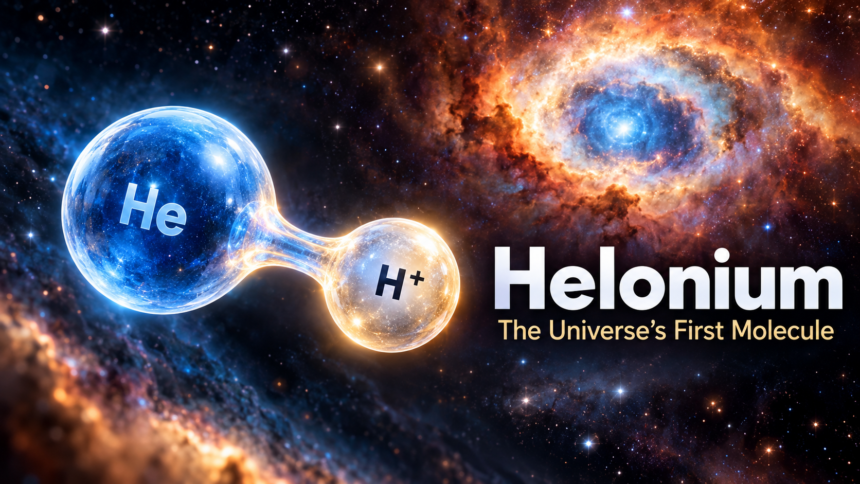
Long before stars began shining or planets formed, the universe was a very different place. There were no galaxies filled with stars, no oceans, and none of the complex chemicals we encounter today. Yet, as the young universe cooled, a simple chemical bond marked the beginning of a remarkable transformation.
That bond formed a molecule known as helonium (HeH⁺), also called the helium hydride ion. Despite its simple structure, helonium holds an important place in science because it is widely considered the first type of molecule to form in the universe.
For decades, scientists understood how helonium could form but struggled to find clear evidence of it in space. Its eventual discovery provided an important confirmation of theories about the earliest stages of cosmic chemistry.
What Is Helonium?
Helonium is a positively charged molecular ion made from helium and hydrogen. Its chemical formula is HeH⁺, and it consists of a neutral helium atom bonded to a hydrogen nucleus, also known as a proton.
Unlike ordinary molecules that contain equal numbers of protons and electrons, helonium carries a positive electrical charge. This makes it a molecular cation rather than a neutral molecule.
Helonium is particularly interesting because helium is normally an extremely unreactive element. Under suitable conditions, however, helium can form a bond with a proton, producing this unusual chemical species.
The molecule is also called helium hydride cation, helium hydride ion, or hydridohelium(1+).
The Chemical Structure
The structure of helonium is surprisingly simple. It contains just two atomic nuclei and two electrons, making it one of the simplest molecular systems involving different elements.
Its positively charged nature allows it to participate in chemical reactions that ordinary helium would rarely undergo.
The basic formation reaction is:
He + H⁺ → HeH⁺ + photon
In this reaction, a neutral helium atom combines with a hydrogen ion. Energy is released as a photon, allowing the newly formed molecular ion to remain bound.
Scientists call this process radiative association.
Although the reaction appears straightforward, it is important for understanding how molecules began forming in space.
How Helonium First Formed
The story of helonium begins after the Big Bang, approximately 13.8 billion years ago.
During the earliest stages of the universe, temperatures were extremely high. Matter existed largely as charged particles, and stable neutral atoms could not form easily.
As the universe expanded, its temperature gradually decreased. Helium nuclei captured electrons to become neutral helium atoms while much of the hydrogen was still ionized.
These neutral helium atoms could then combine with positively charged hydrogen nuclei, creating helonium.
Scientists believe this process occurred during the universe’s early chemical history, within its first few hundred thousand years.
The formation of helonium was significant because it marked the emergence of chemical bonding between different elements in the young universe.
Why Helonium Matters
Helonium was more than an unusual combination of helium and hydrogen. It participated in the early network of reactions that helped produce other molecules.
One important reaction involves helonium interacting with neutral hydrogen:
HeH⁺ + H → H₂⁺ + He
This reaction creates a molecular hydrogen ion, H₂⁺, which can participate in further reactions leading to molecular hydrogen, H₂.
Molecular hydrogen became particularly important because it helped primordial gas clouds lose heat.
As gas cooled, gravity could draw material together more effectively, contributing to the conditions required for the formation of the first stars.
Helonium was one part of this early chemical network. It did not create stars on its own, but understanding its reactions helps scientists reconstruct the processes that preceded star formation.
Its Unusual Properties
Helonium has several properties that distinguish it from more familiar molecules.
One of its most remarkable characteristics is its extreme chemical reactivity. Although the ion can remain stable when isolated, it readily reacts with other substances.
Helonium is also a polar molecule, meaning its electrical charge is distributed unevenly.
This property gives it a permanent electric dipole moment, allowing it to interact with electromagnetic radiation in ways astronomers can measure.
Another interesting feature is its simplicity. Because helonium contains only two nuclei and two electrons, it is useful for testing detailed calculations of molecular structure and quantum behavior.
The molecule therefore has value in both astronomy and theoretical chemistry.
Is Helonium a Strong Acid?
Helonium is often described as one of the strongest possible gas-phase acids because it can transfer its proton to many other substances.
Its extraordinary acidity is connected to helium’s weak tendency to bind an additional proton compared with many other atoms and molecules.
According to the American Chemical Society, researchers regard helium hydride as an exceptionally powerful proton donor.
However, this does not mean helonium can be collected in a bottle and compared directly with familiar laboratory acids.
It reacts so readily with surrounding matter that it cannot be maintained as an ordinary bulk substance.
Its remarkable acidity is therefore primarily a property studied through gas-phase chemistry and theoretical calculations.
Discovery in the Laboratory
Although helonium is associated with the earliest universe, scientists first identified it in a laboratory in 1925.
Chemists Thorfin R. Hogness and E. G. Lunn produced helium hydride ions while investigating the behavior of helium and hydrogen gases under experimental conditions.
Their work demonstrated that helium, despite its reputation for chemical inactivity, could participate in the formation of a positively charged molecular species.
This discovery was important for chemistry, but the astronomical significance of helonium became clearer decades later.
By the 1970s, researchers were developing theories suggesting that helium hydride should exist in certain regions of space.
Finding it beyond Earth, however, proved much more difficult.
Why It Was Hard to Find
Helonium presented astronomers with an unusual problem. Its existence was established experimentally, and scientific models predicted its presence in space, yet direct astronomical confirmation remained elusive.
One major challenge involved the radiation emitted by the molecule.
Helonium produces a distinctive spectral signal in the far-infrared region, including a strong rotational transition at approximately 149.1 micrometres.
Earth’s atmosphere absorbs much of the radiation at this wavelength, making observations from ordinary ground-based telescopes extremely difficult.
Scientists therefore needed instruments capable of observing above much of the atmosphere.
They also had to identify locations where environmental conditions would allow enough helonium to form for its faint signal to become detectable.
The 2019 Space Discovery
<text></text>
A major breakthrough came on 17 April 2019, when researchers reported the first confirmed detection of helonium in an astronomical environment.
The discovery was made using the Stratospheric Observatory for Infrared Astronomy (SOFIA), a flying observatory developed through a collaboration between NASA and the German Aerospace Center.
SOFIA carried scientific instruments aboard a modified Boeing 747 aircraft, enabling observations at high altitudes where atmospheric interference was substantially reduced.
Researchers detected helonium in a planetary nebula called NGC 7027, located approximately 3,000 light-years from Earth in the direction of the constellation Cygnus.
The discovery was published in the scientific journal Nature under the title Astrophysical Detection of the Helium Hydride Ion HeH⁺.
It confirmed that the molecule could exist naturally in space, supporting an important prediction about cosmic chemistry.
What Is NGC 7027?
NGC 7027 is a young planetary nebula formed from gas expelled by an aging star.
Despite its name, a planetary nebula has nothing to do with planets. It is a cloud of gas surrounding a star in a late stage of its evolution.
The central star of NGC 7027 produces intense ultraviolet radiation that influences the surrounding gas.
In certain regions, helium and hydrogen exist in conditions suitable for producing helonium.
This made NGC 7027 an excellent target for astronomers searching for the elusive ion.
Importantly, the helonium detected there was formed in a much more recent astronomical environment. Scientists did not directly observe molecules surviving from the Big Bang.
Instead, the discovery demonstrated that the chemical species predicted to exist in the early universe can also form naturally in the modern universe.
How Scientists Detected It
Astronomers cannot observe individual helonium molecules directly in the way we might examine an object under a microscope.
Instead, they study the radiation molecules emit or absorb.
Every molecular species has characteristic energy levels. When a molecule changes between these levels, it can release or absorb radiation at particular frequencies.
Scientists use spectroscopy to identify these distinctive patterns.
During the 2019 observations, the GREAT spectrometer aboard SOFIA detected radiation corresponding to a known rotational transition of HeH⁺.
The measured signal matched the expected spectral signature, allowing researchers to identify helonium in NGC 7027.
This method demonstrates how astronomers can investigate chemical substances across enormous distances without physically collecting samples.
What Recent Research Shows
The study of helonium did not end with its detection in 2019.
In 2025, research published in Astronomy & Astrophysics examined additional rotational and vibrational observations of HeH⁺ in NGC 7027. The study helped researchers better understand how the molecule forms, becomes excited, and is destroyed in the nebula.
Another 2025 experimental study investigated reactions between helium hydride ions and deuterium atoms, a heavier form of hydrogen.
The researchers found that these reactions can occur efficiently at low collision energies, challenging earlier calculations that predicted slower reactions.
These findings suggest that scientists may need to revise some estimates of how much helonium existed during certain stages of the early universe.
Research published in 2026 has also continued to improve high-precision calculations of helonium’s molecular energy levels.
Together, these studies show that this simple ion remains important for understanding both the chemistry of the early universe and the fundamental behavior of molecules.
Can Helonium Exist on Earth?
Yes, helonium can be produced and studied under controlled laboratory conditions.
However, it is not a substance people normally encounter in everyday life.
Because the ion is highly reactive, it cannot be stored like ordinary helium gas or maintained in a typical chemical container.
Researchers instead produce it in specialized experimental systems, including ion sources and vacuum equipment.
These techniques allow scientists to examine its molecular structure, chemical reactions, and interaction with radiation.
Helonium therefore remains primarily a research subject rather than a material used in everyday products.
Helonium in Modern Science
The scientific importance of helonium extends beyond its status as a possible first molecule.
In astronomy, it helps researchers understand the chemistry of ionized gas, planetary nebulae, and the early universe.
In physical chemistry, it provides a simple system for testing predictions about molecular bonding and proton-transfer reactions.
In quantum physics, its small number of particles allows scientists to compare highly accurate theoretical calculations with laboratory measurements.
Each improvement in these measurements contributes to a better understanding of how atoms behave when they form chemical bonds.
Although helonium has no widespread commercial application, its scientific value is considerable.
Frequently Asked Questions
1. What is helonium?
Helonium is a positively charged molecular ion consisting of helium and hydrogen. Also known as the helium hydride ion, it is widely considered the first type of molecule to have formed in the early universe.
2. What is the chemical formula of helonium?
The chemical formula of helonium is HeH⁺. It represents a helium atom bonded to a hydrogen nucleus, with an overall positive electrical charge.
3. Why is helonium called the first molecule?
Helonium is regarded as the first molecule because scientific models indicate that neutral helium atoms could combine with hydrogen ions during the earliest stages of cosmic chemical evolution, before many other molecular species became abundant.
4. Who discovered helonium?
Helonium was first identified in laboratory experiments by Thorfin R. Hogness and E. G. Lunn in 1925. Its first confirmed astronomical detection was reported in 2019 by an international research team led by Rolf Güsten.
5. Where was helonium found in space?
Astronomers detected helonium in NGC 7027, a planetary nebula approximately 3,000 light-years from Earth. The discovery was made using SOFIA’s airborne telescope and the GREAT spectrometer.
6. Is helonium stable?
Helonium can remain stable when isolated from other reactive substances. However, it reacts extremely easily with surrounding matter, making it difficult to store or maintain under ordinary conditions.
7. Is helonium the strongest acid?
Helonium is considered an exceptionally strong gas-phase acid because it readily transfers its proton to many other substances. It cannot be compared directly with ordinary bottled acids because it cannot be maintained in bulk under normal conditions.
8. How does helonium help scientists understand the universe?
Helonium helps scientists investigate the earliest chemical reactions after the Big Bang. Its formation and destruction provide information about the development of molecular hydrogen and the chemical processes associated with early star formation.
9. Can helonium be found naturally today?
Yes. Its detection in NGC 7027 confirmed that helonium can form naturally in modern astronomical environments where the necessary temperature, radiation, and chemical conditions exist.
10. Does helonium have practical uses?
Helonium does not have common industrial or household applications. Its main uses are scientific, particularly in astrochemistry, molecular spectroscopy, and quantum-mechanical research.
Conclusion
Helonium may be one of the simplest molecular ions known to science, but its significance reaches back to the earliest history of the universe.
From its laboratory identification in 1925 to its long-awaited detection in space in 2019, the helium hydride ion has helped scientists understand how the first chemical bonds could form.
Research continues to reveal new details about its reactions, stability, and role in the development of early cosmic chemistry.
The importance of helonium lies not in its complexity, but in what its existence tells us about the beginning of molecular chemistry. It offers a fascinating connection between the simplest atomic interactions and the much richer universe that eventually emerged.
References
This article was researched using established scientific institutions and peer-reviewed publications.
- NASA — The Universe’s First Type of Molecule Is Found at Last
- Nature (2019) — Astrophysical Detection of the Helium Hydride Ion HeH⁺
- American Chemical Society — Helium Hydride: Molecule of the Week
- Max Planck Institute for Radio Astronomy — First Astrophysical Detection of the Helium Hydride Ion
- Astronomy & Astrophysics (2025) — Chemistry and Ro-vibrational Excitation of HeH⁺ in NGC 7027
- Astronomy & Astrophysics (2025) — Experimental Confirmation of Barrierless Reactions Between HeH⁺ and Deuterium
- Physical Review A (2026) — Relativistic and QED Corrections for HeH⁺
Read also How an OnlyFans Agency Helps Creators Grow: Management, Marketing & Revenue Strategy